Predictable marketing
with fixed outcomes

You know the deliverables, timeline, price, and acceptance criteria before work starts.

You pay for approved deliverables, not time spent.

Campaigns Funnels Creatives Analytics Automation
No commitment. No instant pricing.

Why marketing execution loses control

System response
Scope expands mid-campaign
→ Changes require explicit approval
“Progress” is subjective
→ Progress is based on accepted deliverables
Key decisions get lost in chats
→ Every decision is documented
Core rule
Work starts only after boundaries and acceptance criteria are agreed.

You pay for approved results, not hours

When campaign scope is not fixed, timelines drift and accountability shifts to you. It becomes unclear what will be delivered, when execution ends, and what counts as completion.

If the full marketing strategy is not clear yet, we define and deliver one fixed scope at a time. Each scope includes only what can be explicitly agreed upfront.

Direct execution

You work directly with the people accountable for campaign outcomes. No layers in between. No lost context.

One clear owner
One person is accountable for deliverables from start to acceptance.
No hidden handoffs
Work does not pass through managers or messengers.
No silent changes
Any change is discussed and approved before execution continues.
Shared context
Decisions, assets, and constraints stay visible to everyone involved.

You receive approved, locked marketing results

Each stage ends with a concrete deliverable you review and approve. Progress is tracked by accepted outputs, not hours, calls, or vague updates.

Nothing changes without review. No assets are modified silently.

Step 01

Scope is fixed

Boundary

Before execution starts, we define what is included, what is excluded, and what counts as accepted.

Deliverables list
Acceptance rules
Change limits
Step 02

Decisions are written down

Record

Key campaign decisions are documented so later work cannot quietly change their meaning.

Targeting choices
Constraints
Reasoning
Step 03

Deliverables are produced

Output

You receive concrete marketing outputs to review, depending on the stage.

Creatives or copy
Tracking rules
Funnel updates
Step 04

Result is approved and saved

Reference

Once approved, the deliverable becomes the fixed reference for all next execution.

Approval record
Final snapshot
Locked baseline

What you see as a Client

You see what is approved, what is locked, and where each campaign stage stands — all in one place.

Read-only after approval
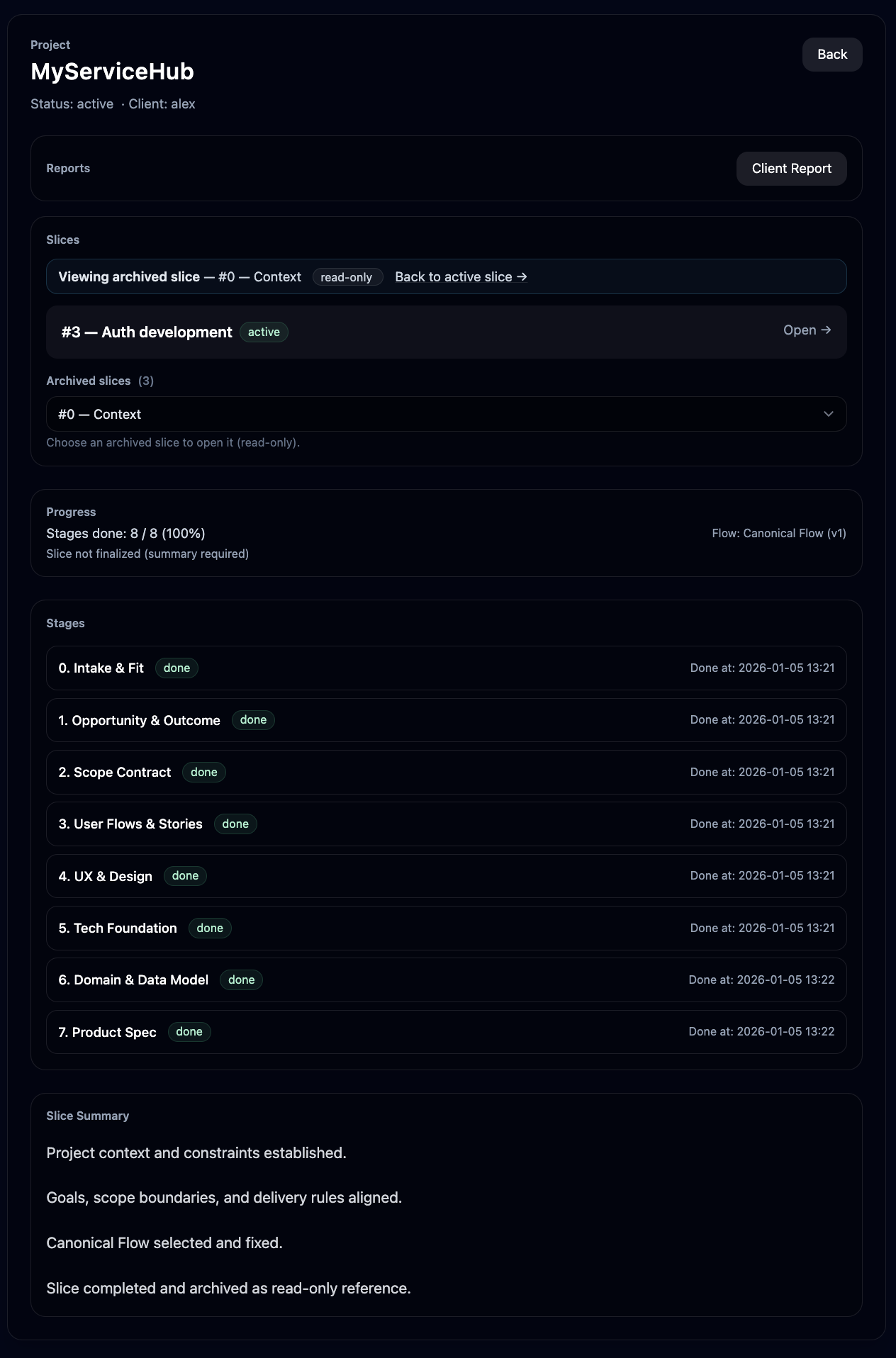
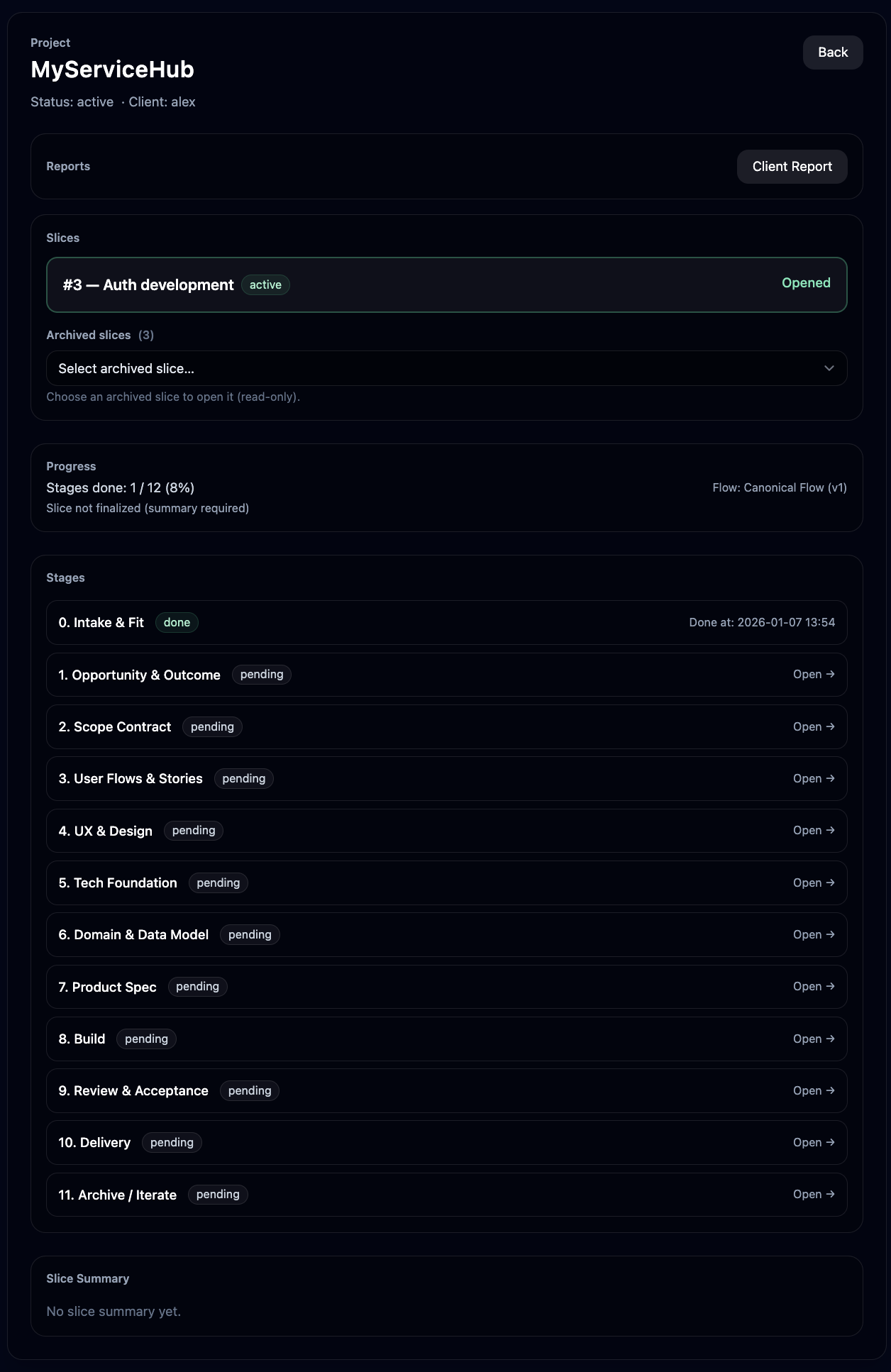
Proof 01

Approval and pending states are explicit

In progress

If a stage is not approved, it stays pending. No vague status updates.

Campaign stage with approval and pending states
pending active read-only
Pending means not approved yet.
All approvals are visible.
Proof 02

Completed stages are fixed

Completed

When a stage is completed, the deliverable is locked and summarized.

Completed stage with summary
done 100% read-only
Clear done state.
Summary preserves decisions.
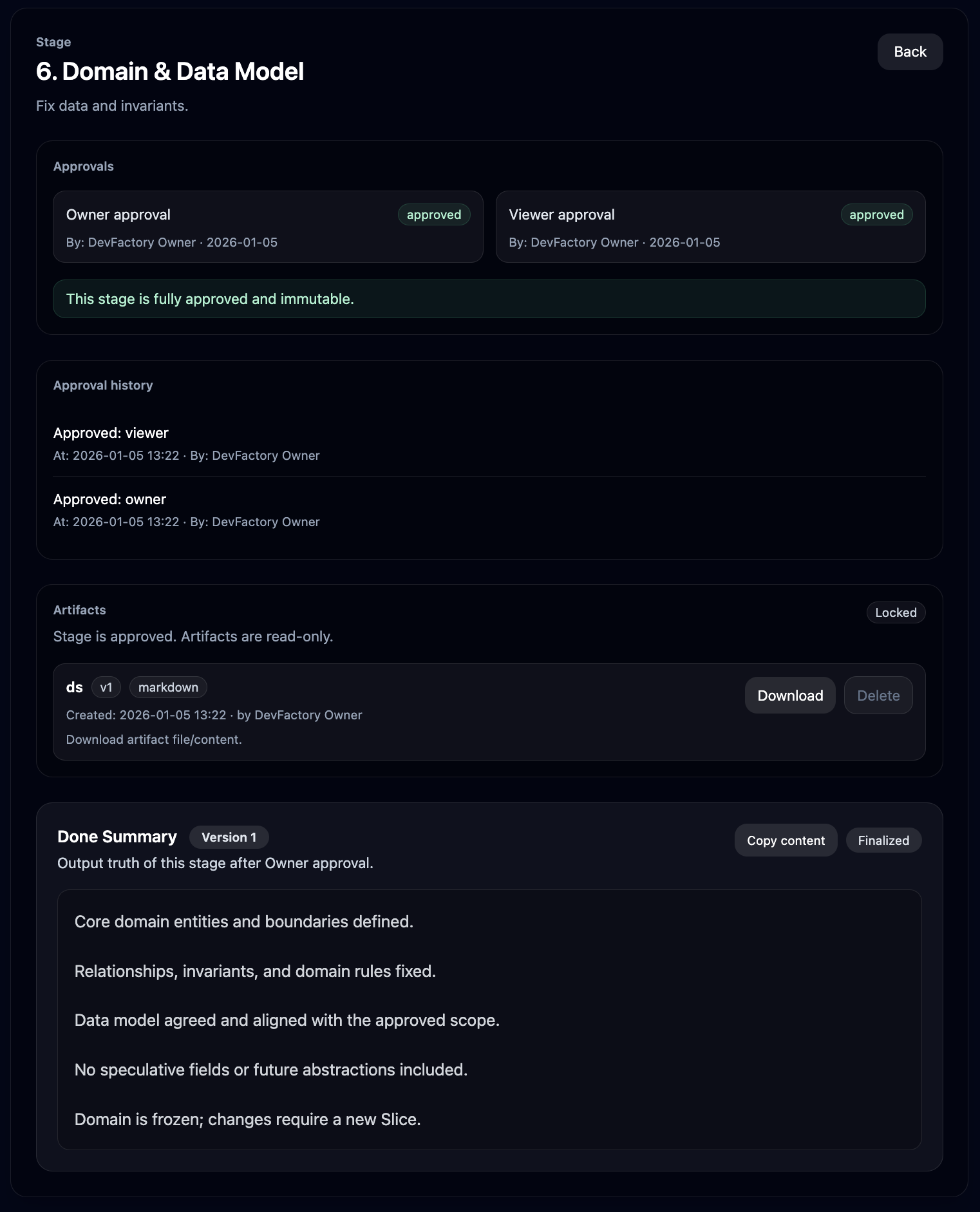
Proof 03

Approved assets are read-only

Read-only

You can view and download assets. Approved history cannot be changed.

Read-only assets and summary
locked read-only approved
Assets are accessible.
Changes require a new stage.
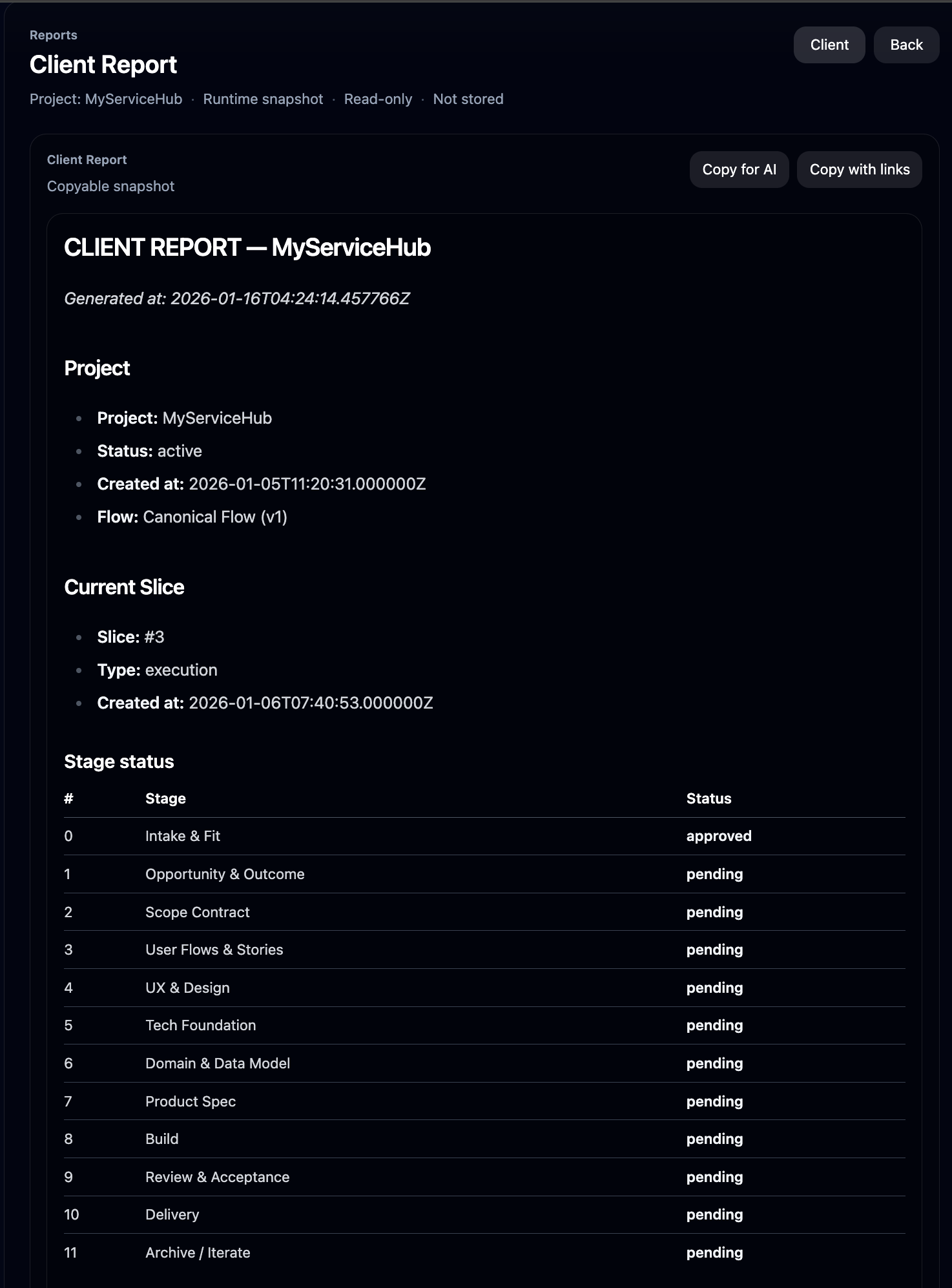
Proof 04

Client report is generated automatically

Report

The report reflects current stage states. No manual updates.

Client report snapshot
snapshot read-only copy
No manual status writing.
Same data, same report.

Guarantees that reduce execution risk

These guarantees are enforced by the delivery model itself, not by promises or informal agreements.

No silent changes
Once approved, deliverables are locked. Any modification requires a new stage and explicit approval.
No scope creep
Each campaign scope has fixed boundaries. Additional work means a new scope.
No invisible progress
Progress exists only as approved outputs and explicit completion records.
No lost context
Decisions, assets, and results remain accessible long after execution.

This delivery model is already in use

The same approval, scope, and output rules are applied in real marketing execution — not as a concept, but as an operating system.

  • teadmus.org — Content-driven platform executed with fixed scopes, staged approvals, and traceable results.
  • rush-app.com — Marketing site delivered with locked deliverables and zero mid-scope drift.

Questions before you request evaluation

Answers based on what you actually see as a client: approved deliverables, locked results, and accepted execution stages.

Is this an agency-style setup?

No. You work directly with the people accountable for campaign results. No intermediaries, no message passing.

Do I pay for time or for results?

You pay per fixed scope. Each scope has defined deliverables, a fixed boundary, and an explicit approval point.

What does “read-only after approval” mean?

Once approved, deliverables cannot be modified. Any change requires a new execution stage and approval.

What will I see during execution?

Approved assets, short stage summaries, and the final accepted result — all in one place.

What if I change direction mid-campaign?

A significant change becomes a new scope. Previous results remain as approved history.

Can execution be paused and resumed later?

Yes. All decisions and outputs are saved, allowing work to continue later without lost context.

Can another team continue later?

Yes. Another team can continue using the same approved deliverables, constraints, and history.

Is this a task tracker or project board?

No. This system is for controlled marketing delivery and approved outcomes, not task tracking.

What is intentionally not included?

Time tracking, task boards, chat systems, timelines, and automation dashboards.

Campaign evaluation is not a quote

This step is about clarifying the outcome and deciding if execution should start at all.

Evaluation request
Required fields are marked
Only email and outcome are required. No obligation.